
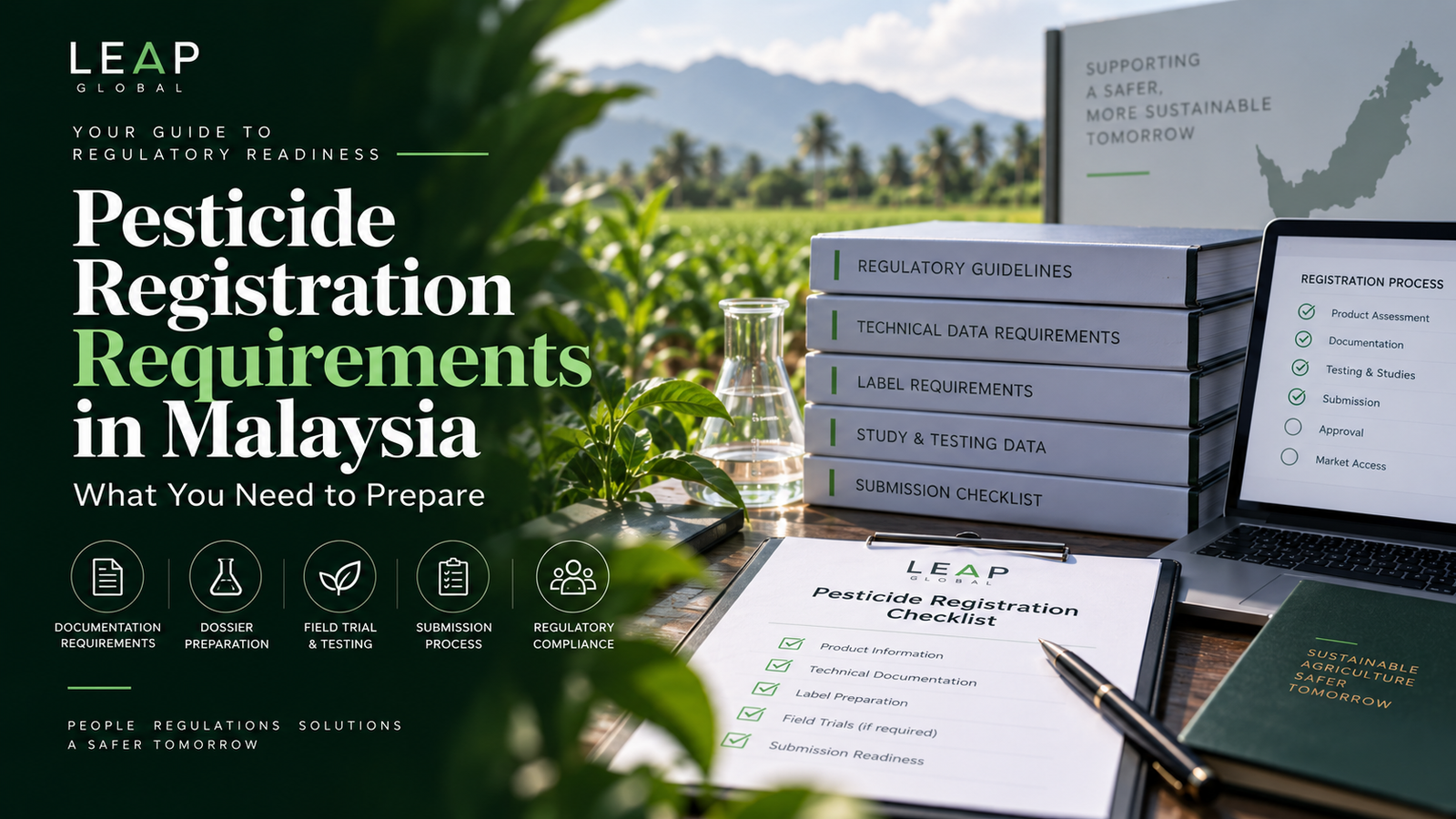
Registering a pesticide product in Malaysia requires careful preparation and an understanding of the regulatory pathway applicable to the product.
For manufacturers, formulators, distributors and brand owners, one of the biggest challenges is knowing what needs to be prepared before starting the registration process.
The requirements are not simply about collecting documents. A registration project may involve product assessment, regulatory strategy, dossier review, label preparation, identification of data gaps, submission management and coordination with laboratories or field trial providers where additional studies are required.
LEAP GLOBAL provides independent, team-based regulatory support for businesses navigating pesticide registration in Malaysia, helping clients understand the regulatory process and coordinate the different activities involved.
What Are the Pesticide Registration Requirements in Malaysia?
The requirements for a pesticide registration project depend on the product and its specific regulatory circumstances.
This is important because not every pesticide registration project starts from the same position.
A company may already have an established product dossier, while another manufacturer may be preparing a product for a new market. The available data, product classification and regulatory considerations can therefore differ from one project to another.
LEAP GLOBAL’s approach is to assess each project according to its specific product, data status and regulatory considerations before providing guidance.
A useful way to think about the preparation process is through several key areas:
- Product and regulatory assessment
- Registration strategy
- Dossier preparation and review
- Data gap assessment
- Label preparation
- Supporting studies
- Submission preparation
- Regulatory authority communication
- Post-registration requirements
Let’s look at each area in more detail.
1. Understand Your Product First
Before preparing a registration dossier, it is important to understand the product being registered and its regulatory position.
This is where product classification assessment becomes relevant.
Different products can have different regulatory considerations, and the appropriate registration pathway should be considered before substantial preparation begins.
LEAP GLOBAL provides regulatory consultation and product classification assessment as part of its Regulatory Strategy & Consultancy service.
Starting with this assessment can help businesses establish a clearer direction before moving into detailed registration preparation.
2. Develop the Right Registration Strategy
A registration strategy provides a framework for how the project should be approached.
Rather than immediately preparing every available document, businesses can first consider:
- What registration pathway is appropriate?
- What information is already available?
- Are there potential regulatory gaps?
- What additional activities may be required?
- What parties need to be involved?
- How should the registration project be coordinated?
LEAP GLOBAL’s regulatory strategy services include:
Regulatory consultation
Product classification assessment
Registration strategy
Dossier gap assessment
Regulatory pathway planning
For overseas manufacturers entering Malaysia, this early planning stage can be particularly valuable when the company is unfamiliar with the local regulatory environment.
3. Review Your Pesticide Dossier
A key part of preparing for pesticide registration is understanding the status of the available dossier.
A company may already have technical documentation prepared for another market. However, the existence of an international dossier does not automatically mean that the registration project is ready to proceed without further assessment.
A pesticide dossier review can help identify:
- Information that is already available
- Areas requiring further review
- Potential data gaps
- Inconsistencies between documents
- Information that may require additional consideration
LEAP GLOBAL specifically provides dossier gap assessment as part of its regulatory strategy services and dossier review as part of registration management.
This allows the regulatory team to understand the project’s current position before the submission stage.
4. Identify Potential Data Gaps
One of the most important steps in pesticide registration preparation is identifying potential gaps early.
A data gap does not necessarily mean that a project cannot proceed. Rather, it highlights an area that may require further assessment, supporting information or an appropriate regulatory approach.
This is why pesticide dossier gap analysis should ideally be considered before finalising the registration submission.
LEAP GLOBAL’s approach focuses on identifying potential gaps early and maintaining consistency across the dossier throughout the registration process.
Early identification can also make project coordination more manageable because additional activities can be considered before they become last-minute requirements.
5. Prepare and Review the Product Label
Product labelling is another important part of registration preparation.
LEAP GLOBAL provides:
- Label preparation
- Compliance review
- Dossier review
as part of its pesticide registration management services.
For companies with existing product labels from overseas markets, the regulatory team can review the available information as part of the overall project and consider the requirements relevant to the Malaysian registration pathway.
The key objective is to ensure that label preparation is treated as part of the wider registration project rather than as an isolated task.
6. Consider Whether Additional Studies Are Required
Some pesticide registration projects may require additional testing or studies.
When this happens, coordination becomes an important part of the project.
LEAP GLOBAL works with clients, qualified field trial providers and accredited laboratories when field trials, residue analysis or other relevant studies are required.
Its Field Trial & Residue Analysis Coordination service is designed to coordinate these activities as part of the wider registration project.
This includes:
- Field trial coordination
- Residue analysis coordination
- Working with qualified trial providers
- Working with accredited laboratories
- Third-party coordination
- Project coordination
For overseas companies, having a central project coordinator can help reduce the administrative burden of dealing with multiple parties separately.
7. Prepare for the Registration Submission
Once the relevant preparation has been completed, the registration submission needs to be coordinated carefully.
LEAP GLOBAL provides support across several submission-related activities, including:
Online & Hardcopy Submission
Supporting the coordination of the required submission activities.
Regulatory Authority Liaison
Communicating and coordinating with the relevant regulatory authorities.
Regulatory Correspondence
Managing regulatory correspondence and authority engagement.
Query Management
Supporting the handling and coordination of regulatory queries.
Import Permit Applications
Providing support for import permit applications where relevant.
Data Waiver Applications
Providing support for data waiver applications where applicable.
The submission stage therefore forms part of a wider registration management process rather than being treated as a standalone administrative task.
8. Keep the Dossier Consistent
One area that can easily be overlooked is consistency.
A pesticide registration project can involve information coming from different documents, departments, manufacturers, laboratories and third-party providers.
Keeping the information consistent across the dossier is therefore an important part of regulatory preparation.
LEAP GLOBAL specifically highlights:
Identifying potential gaps early
Ensuring consistency across the dossier
Maintaining clear communication throughout the process
These principles form part of the company’s approach to regulatory support.
A structured review process can help the project team maintain a clearer overview of the information being submitted.
9. Prepare for Regulatory Queries
Submitting an application does not necessarily mean that the regulatory work is finished.
Regulatory correspondence and queries may require further coordination and clarification during the registration process.
LEAP GLOBAL provides regulatory correspondence, authority engagement and query management as part of its registration management services.
Having a regulatory team involved throughout the project can help ensure that communication is coordinated and that clients remain informed as the project progresses.
10. Consider Registration Renewals and Variations
Regulatory support can also extend beyond an initial registration.
Once a product is registered, businesses may require support with ongoing registration matters.
LEAP GLOBAL provides support for:
- Registration renewals
- Variation applications
These services form part of its broader pesticide registration management offering.
For companies managing multiple products, having ongoing regulatory support can help them keep track of future registration-related activities.
Pesticide Registration Preparation Checklist
Before beginning a pesticide registration project in Malaysia, businesses can consider the following checklist:
Product
☐ Understand the product and its regulatory position
☐ Assess the appropriate product classification
☐ Understand the intended registration pathway
Regulatory Strategy
☐ Develop a registration strategy
☐ Identify potential regulatory challenges
☐ Plan the regulatory pathway
Dossier
☐ Review existing documentation
☐ Assess the current dossier
☐ Identify potential data gaps
☐ Check consistency across documentation
Label
☐ Prepare product labelling
☐ Review label compliance
Studies
☐ Determine whether additional studies may be required
☐ Coordinate field trial activities where applicable
☐ Coordinate residue analysis where applicable
☐ Work with qualified trial providers and accredited laboratories
Submission
☐ Prepare submission materials
☐ Coordinate online and hardcopy submission
☐ Manage regulatory correspondence
☐ Prepare for regulatory queries
Ongoing Registration
☐ Plan for registration renewals
☐ Consider variation applications where required
Why Early Regulatory Planning Matters
One of the most common challenges businesses face is waiting until the registration stage to identify problems.
By assessing the project earlier, companies can gain a clearer understanding of:
What they already have
What may be missing
What needs further assessment
Who needs to be involved
How the registration project should be coordinated
This is particularly important for overseas manufacturers because their existing regulatory information may have been prepared for another market.
LEAP GLOBAL’s approach is to assess each project carefully and provide guidance based on its specific needs rather than assuming that every product follows exactly the same path.
Why Choose a Team-Based Pesticide Regulatory Consultant?
Preparing a pesticide registration can involve multiple activities and stakeholders.
LEAP GLOBAL differentiates itself through a team-based regulatory model, rather than positioning itself as a single freelance consultant.
The company’s stated differentiators include:
- Specialised expertise in Malaysian pesticide regulations
- Independent advice
- Dedicated team support
- Personalised service
- Genuine care
- Clear communication
This team-based approach is particularly relevant for companies that need ongoing coordination throughout a registration project.
Who Needs Pesticide Registration Support in Malaysia?
LEAP GLOBAL supports businesses including:
- Overseas chemical pesticide manufacturers
- Biological pesticide manufacturers
- Biocide and microbial product companies
- Agrochemical companies
- Formulators
- Distributors
- Brand owners
- Local pesticide registrants
- Biopesticide companies
- Household insecticide companies
- Public health product companies
- Wood preservative companies
Whether the business is preparing its first pesticide registration in Malaysia or managing an ongoing registration matter, the regulatory requirements should be considered according to the specific project.
Frequently Asked Questions
What are the pesticide registration requirements in Malaysia?
Pesticide registration requirements depend on the specific product and regulatory circumstances. Preparation may involve regulatory strategy, product classification, dossier review, data-gap assessment, label preparation, supporting studies, submission management and regulatory correspondence.
What documents are needed for pesticide registration in Malaysia?
The exact documentation requirements should be assessed according to the product and registration pathway. LEAP GLOBAL provides dossier review and gap assessment to help clients understand the status of their available information and identify areas requiring further attention.
Can an overseas company register a pesticide in Malaysia?
Overseas manufacturers are among LEAP GLOBAL’s target clients. The regulatory team supports international companies in understanding Malaysian pesticide regulatory requirements and coordinating their registration projects.
What is a pesticide dossier gap assessment?
A dossier gap assessment reviews the available information and identifies potential areas that may require additional information, assessment or regulatory consideration before proceeding further with the registration project.
Does pesticide registration always require field trials?
The onboarding information does not state that every pesticide registration requires field trials. LEAP GLOBAL provides field trial and residue analysis coordination when testing or additional studies are required.
Can LEAP GLOBAL help with pesticide registration renewals?
Yes. Registration renewals and variation applications are included within LEAP GLOBAL’s pesticide registration management services.